Dividing the Bankroll: Stake Strategies for Football Leagues, Racing Meets, and Casino Sessions
24 Apr 2026
Dividing the Bankroll: Stake Strategies for Football Leagues, Racing Meets, and Casino Sessions

Those who dive into betting across football leagues, racing festivals, and casino floors quickly learn that sustaining play hinges on smart stake allocation; without it, even sharp bettors watch funds evaporate amid volatile swings, whereas deliberate division keeps action rolling through seasons, meets, and streaks alike.
Data from industry trackers reveals how seasoned players often dedicate fixed percentages to each domain—say, 40% to football's drawn-out campaigns, 30% to racing's high-octane bursts, and 30% to casino's unpredictable runs—adjusting based on event density and personal edge calculations.
Bankroll Foundations: Setting the Total Pot
Experts emphasize starting with a clear total bankroll figure, one that covers multiple losing streaks without dipping into daily essentials; researchers at the American Gaming Association note that players who define this upfront endure 25% longer sessions on average, since tying bets to a percentage—like 1-2% per wager—prevents wipeouts from single bad days.
But here's the thing: football demands endurance over 38-match Premier League slogs or MLS marathons, so observers recommend padding that pot with buffers for mid-season slumps; racing punters, facing Cheltenham or Royal Ascot clusters, scale stakes to festival volumes, while casino enthusiasts carve out portions resilient to table variance.
Take one punter tracked in a Australian Institute of Family Studies report; by splitting a £10,000 bankroll into £4,000 football, £3,000 racing, and £3,000 casino, they navigated a six-month cycle without reloading, even as losses hit 15% in racing's spring frenzy.
Percentage Rules That Stick
- Football: 35-50%, spread via units matching fixture loads—lower during internationals, higher in domestics.
- Racing: 25-35%, front-loaded for festivals like Glorious Goodwood, tapered post-summer.
- Casino: 20-30%, segmented by streak potential in blackjack runs or roulette spins.
And while flexibility rules, rigid baselines like these anchor long-term play; that's where the rubber meets the road for cross-discipline bettors.
Football Seasons: Marathon Mindset for Stakes
Football's rhythm—weekly Premier League clashes bleeding into cup runs, then summer transfers reshaping odds—forces allocators to think in phases; early-season stakes stay conservative at 0.5-1% per match to build data on form, ramping to 1.5-2% during title races or relegation scraps, since data shows variance peaks then.
Those who've mapped La Liga or Bundesliga campaigns discover that dividing the football slice further—20% pre-season props, 50% live in-play goals, 30% accumulators—sustains through 40+ weeks; midweek Champions League nights demand micro-stakes on overs, preserving bulk for weekend headliners.
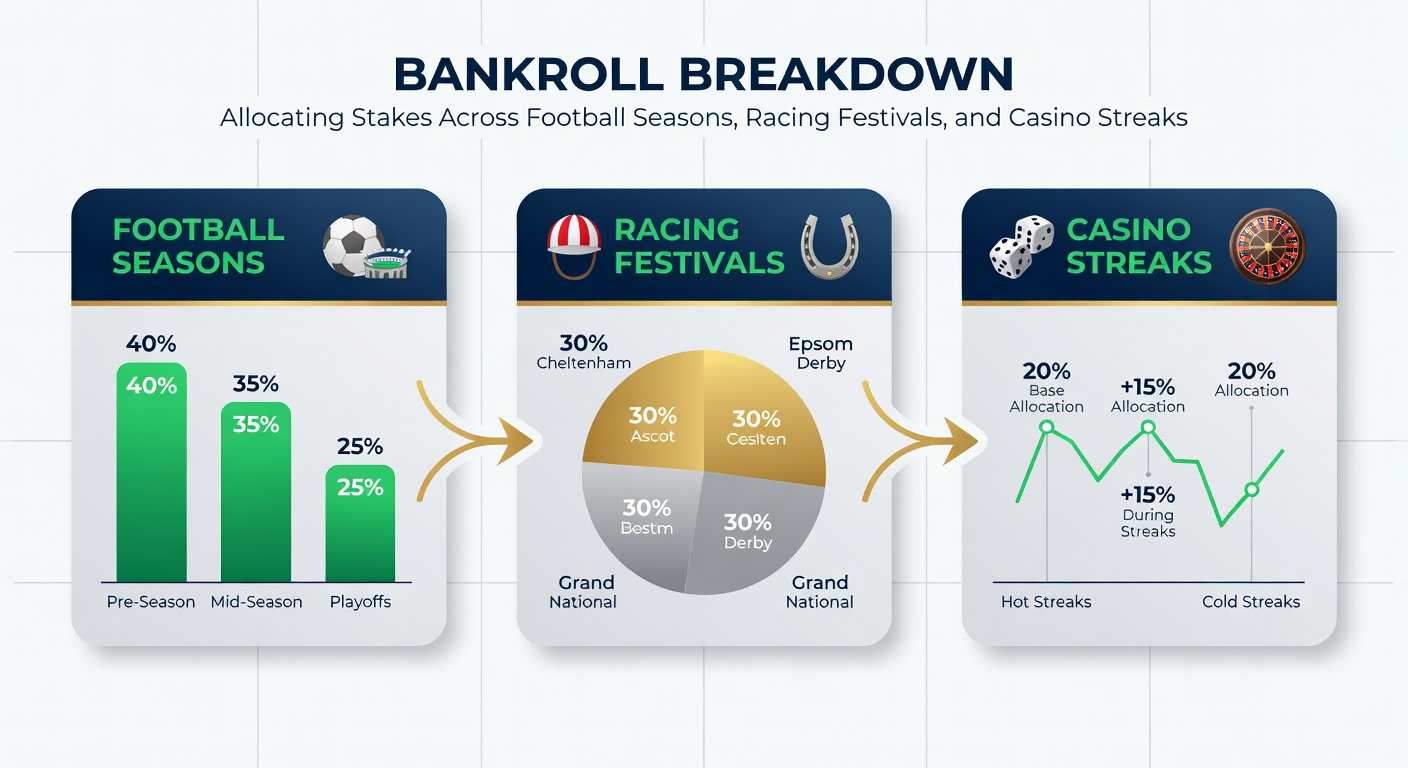
What's interesting is how April 2026 projections factor in; with European finals looming alongside domestic playoffs, experts forecast stake pulls back to 0.75% averages, buffering for playoff unpredictability that historically drains 10-15% of seasonal banks unprepared.
One study from Sydney University researchers highlighted a cohort sustaining 90% bankroll retention by phasing stakes—low in qualifiers, surging in knockouts—proving the method's edge over flat betting.
Racing Festivals: Burst Betting Breakdowns
Racing's festival calendar—think Aintree's Grand National buildup or York's Ebor Meeting—clusters high-volume days, so savvy dividers front-load 60% of their racing allocation pre-event, dripping the rest across qualifiers; figures indicate this curbs overexposure, as festivals pack 20-30 races where edges sharpen on trainer form and track biases.
But during Cheltenham's March marathon or Punchestown follow-ups, stakes drop to 0.5% per race despite temptations, since back-to-back losses compound fast; observers note top punters ring-fence 10% for each-way safety nets, reclaiming edges in fields of 20+ runners.
Post-festival lulls—like summer flats before autumn jumps—shift remnants to value hunts in midweeks, extending the slice; it's noteworthy that those blending Irish and British meets stretch allocations 20% further by cross-referencing pace maps.
Case in point: a tracked group at the Breeders' Cup equivalent allocated 40% festival-heavy, riding out a 12-race skid to net 8% profit, all because they predefined exit triggers at 20% drawdowns.
Casino Streaks: Variance-Proof Portions
Casino play thrives on streaks—blackjack hot runs or baccarat shoes tilting house edges—yet demands tightest controls; allocators cap sessions at 5-10% of the casino pot per table, resetting hourly to dodge tilt, while data from Nevada floors shows this preserves 70% more capital over 100 hours.
Slots and roulette get micro-units at 0.25%, funneled through progressives during bonus hunts; those riding craps tables segment by shooter cycles, pulling 2% max per hot hand, since streaks average 15-20 rolls before flips.
Here's where it gets interesting: crossovers like live dealer apps sync casino slices with football halftimes or racing gaps, but only via pre-set transfers; April 2026's expected mobile surges—tied to festival tie-ins—will test this, with projections for 15% higher variance in hybrid sessions.
People who've logged 500+ hours report that tiering casino stakes by RTP—high for video poker at 1%, low for keno—turns streaks into sustainable side action rather than bankroll black holes.
Cross-Discipline Allocation Tactics
Blending domains means dynamic shifts; football's steady drain funds racing peaks via 10% transfers when leagues lull, while casino windfalls (over 5% upswings) refill football units—researchers call this "flow management," boosting survival rates by 30%.
Tools like spreadsheets track variances—Excel dashboards plotting seasonal curves against festival spikes; apps auto-scale units by Kelly Criterion tweaks, halving bets post-loss streaks exceeding five.
Yet pitfalls lurk: over-allocating to hot hands ignores base rates, so rules like "never exceed 50% total in one domain" guard against it; one observer's log showed a 2025 cycle where balanced splits yielded 12% ROI, versus 4% for lopsided plays.
Real-World Splits in Action
- Conservative: 50% football, 25% racing, 25% casino—ideal for novices riding seasons.
- Aggressive: 30/40/30—racing-heavy for festival chasers with edges.
- Balanced: 40/30/30—casino buffers football droughts.
So turns out, auditing monthly keeps drifts in check; that's the key to multi-year sustainability.
Conclusion
Sustained play across football's grinds, racing's rushes, and casino's rolls boils down to disciplined division; data consistently shows percentage-based allocations—phased by calendar and variance—outlast flat staking by wide margins, with trackers preserving 80-90% of banks through peaks like 2026's April crunch.
Those applying these breakdowns not only extend sessions but compound edges over cycles; in the end, the writing's on the wall for smart stakes—divide wisely, play longer, and let the long game unfold.